

The Commentary - Issue One
The Commentary Begins: Editor’s Note
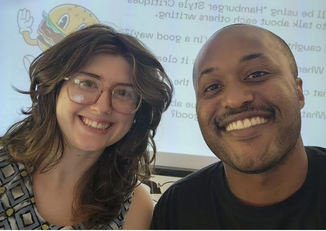
Your editors,
Neil Martin & Heather Hershberger
We are providing you with on-the-streets journalism to help sustain and grow Pittsburgh’s engagement with the arts. Wick Monet is pleased to present a collection of works by local writers and artists. These writers are engaged in authoring a series of commentaries on local artists, art happenings, and galleries. I promise, the coolest shit happening in Pittsburgh is in this paper.
You, dear reader, have the power to do your part for the community just as much as these writers. I ask you to feel inspired by them, visit the places that they visited, argue about their takeaways, and go to places they haven’t. Consider this your formal invitation to engage with the creatives around you. Support them, support your city.
This is a community, this is a collective. This is the Pittsburgh Artistic Community.
@wickmonet
Review: Barebones Theatre’s Production of Animal Kingdom
By: Spencer Byham-Carson
I drove to Braddock, seeing the sunset through wires and smoke produced from the steel industry, for a theatrical event that I was not excited for; I was leaving for New York the following day, my friends were currently at home without me, and the ticket cost 53 dollars, but I make theater. It is important, every once in a while, to experience what you make. The price remained what I was most apprehensive/frustrated about. I mean, “How good could the play be,” or rather “How good does this play have to be to make my 53 dollars worth it?”
Habitually anxious about showing up late, I arrived 20 minutes early by accident for the production of Animal Kingdom and had to awkwardly fill my water bottle next to my old professors. Graduating only a month ago with a degree in directing from Carnegie Mellon, I've either been a part of or seen many of my professors work in the local theater scene and yet we still lack a comfortable report. “Is it me or them,” I think. We traded cordial ‘hellos’ as I took my front-row seat. The audience was configured in a 3/4s thrust within a converted Braddockian building. Avoiding eye contact in the extended period pre-show in which I was in my seat, allowed me to observe the space. Tilting my head back to the ceiling, I counted 7 lights hanging, that is not a lot, but Barebones Productions doesn’t work with a lot. The set echoed this minimal mantra as it consisted of 5 chairs, a small side table, and a jug of water. “Water on stage is good for actors,” I thought, and “have one less chair than the number of characters in a scene; give the actors something to fight for,” I remembered my professor, Will Davis, saying. But I glanced at the program to see that there were 5 actors and, once again, 5 chairs. Strike…whatever, I felt in a sour mood, not a good place to be, so I spoke to no one and waited until the lights dimmed, the actors took their places, and the show started.
In the play by Ruby Thomas, we follow a young man (Grayson Taylor), in a post suicide attempt, in a hospital with his parents (Darren Elicker and Daina Michelle Griffith) and sister (Alexandra Casey) visiting him for much-needed group family therapy sessions. I saw myself in the young man, the naivete, the loneliness, the selfishness, and, thank god, the improvement by the time the lights came back up. It was a very cathartic and collective experience with the audience, which is what I look for when I go to the theater. I could hear sniffling throughout and even a vocal “oh yeah,” when the father awkwardly hugged his son, choreographed by the therapist (Juan Rivera Lebron). Rivera Lebron’s performance impressed me in its subtlety, as every other character had a multi-page-and-minute monologue to flex their acting skills, but Juan kept the show afloat delivering a quietly impressive and powerful performance.
Actor Grayson Taylor, a Carnegie Mellon student, was complicated, made legible, and created a well of sympathy in their portrayal of this lost young man. Elicker and Griffith, as the parents, created a comedy of butting personalities through divorcees unable to keep their issues out of the mess. Finally, Casey, as Taylor’s sister, bottled her frustration at her brother for his suicide attempt, uncorking a well-deserved monologue in the final minutes of the play reframing the dynamics—a real “turning up the gas burner on the stove to Hi” performance.
“I saw myself in the young man, the naivete, the loneliness, the selfishness, and, thank god, the improvement...”
The majority of the directing was invisible, done by Patrick Jordan, Founder and Artistic Director of the theater company, whose daughter stood next to him at the box office as he also tore tickets for admittance, asking passers-by if they wanted to play horses with her. I’d like to emphasize that Invisible directing is a non-pejorative term that I’ve created, meaning that there is no broad ‘concept’ for the production. Jordan possesses a keen eye for scripts that simply work. This still means that he has to find the rhythm with the actors, guide them through the process, and be the constant motivator at the center of the project, the script can only do so much. The only parts of the directing that were visible to me were, due to the aforementioned 3/4ths thrust, where the audience surrounds the stage on 3/4ths of the sides, whenever it was time for each actor's big monologue there was the one chair facing out to the entire audience that they would take a seat in. By the third time it happened, I started to catch on and came to expect it. The rest of Patrick’s directing remained subtle in a very pleasing way which allowed the actors and the text to shine.
All that remains for me is the question of whether 53 dollars is a worthy price for a ticket: Theater, as a whole, feels like it is becoming more inaccessible to the average person. How many people can spend 53 dollars per ticket? Additionally, hypothetically, adding on costs such as transportation, babysitter, or dinner at the restaurant directly attached to your theater, prices become further out of reach. I thought of Patrick and his young daughter working the ticket booth, and I am sure 53 dollars per ticket is what Patrick has to charge to continue to create local, powerful art, of a dying artform that I too love.
The Value of The Death of An Original
by Elizabeth Dawn of Memoirtistry.com
In his autobiography, Dear Theo, Vincent Van Gogh intimately pens the artist’s struggle to his brother. “Painters … dead and buried, speak to the next generation or to several succeeding generations in their work. Is that all, or is there more besides? In a painter’s life death is not perhaps the hardest thing there is.”
What is it that Van Gogh is saying? The hardest thing: to be valued in life as the artist one is. World-renowned only in death, his words beyond the grave paint a picture of the trauma of poverty. “I as a painter shall never stand for anything of importance, I feel it utterly. But if all were changed, character, education, circumstances, things might be different.”
Van Gogh waxes poetic the effects that poverty has on a person’s mental health. He even says money would only distract him from his work—a thought I’ve voiced myself, trying to rewrite feelings of worthlessness. We like to say the struggle is what “make us”, but it is not poverty that makes a person, it is poverty that defeats a person. Van Gogh committed suicide; inside these pages is a man defeated, unable to envision a future. I have suffered similar symptoms.
“… the new painters alone, poor, treated like madmen and because of this treatment actually becoming so, at least as far as their social life is concerned … the money painting costs crushes me under a feeling of debt and worthlessness, and it would be a good thing if this state of things could cease.”
IIf he was a madman, I am a madwoman. Diagnosis does not diminish one’s genius. Becoming an artist—having the integrity to live by my internal compass in the face of adversity and adjusting my life’s entire focus to support my mental health through my practice, Memoirtistry®—has impacted my status in class and career. The loss of invitations because I can no longer pay my way has isolated me. The weight of the absence of a four-year degree is used against me, still; as if my life has taught me nothing. I am poor in the bank. I receive government assistance for food each month. I seek free things. I steal from corporations. I take only what I need and I use all of what I have. Nothing is without purpose. My desires for material things have waned as the money I do receive I pour back into my art.
What you see inside Dear Theo is the artist dismissed in life but capitalized upon in death—a story written of living artists pursuing their craft, that struggle is a “rite of passage,” distracting us from finding solutions for poverty to support mental health. Not everyone has the same opportunities afforded them, and when you are in poverty you are separate from society. You are a have-not, and are treated as such.
Van Gogh’s appearance, demeanor, lack of social standing, lack of college education, and poverty status affected his impression. He appeals to his brother to forgo comments on his dress—an oversized wool coat of his father’s and even Theo’s too-large hand-me-downs—as it is all he has. Things about him that could not be changed without money or generosity, criticized. When you live day-to-day, what little money you receive, you apply to the most pressing need. For Van Gogh, painting was a greater need than eating; he often fasted and moved about looking for the most affordable accommodations. “Society being what it is, we naturally cannot expect it to conform to our personal needs.”
The needs expressed within the pages were not exorbitant; most he mentioned were basic, human. He speaks of a dream life in an artist’s commune; a peaceful environment where money is not a constant pressure, so he could do his work the way his mastery and his mental health required. I have ached for the same. During one of his periods of being institutionalized for his “madness”, he commented, “They have lots of room here in the hospital; there would be enough to make studios for a score or so of painters.”
How much more could Vincent have created if his basic needs were supplied?
On July 17, I attended an artist focus group at the Equity Impact Center through Sweetwater Center for the Arts. The EIC partners with local nonprofit and social justice organizations to support the evolution of outdated and harmful systems. We discussed the needs of the artist and were fed and paid for our time. The EIC defines equity as “the creation of conditions and experiences of situational fairness, transparency, and accountability achieved when we apply differential resources to address unequal needs because people are situated differently.” The conversation revived my belief I can make a difference with my own difference.
The prosperity gospel of capitalism paired with the toxicity of manifestation keep those in comfort distracted from the reality that people are situated differently. Van Gogh was blessed to have the support of his brother, but often felt himself a financial burden to Theo. “I am glad you are of the opinion that it would be unwise to take some outside job in hand at the same time. This leads to half measures which make half a man of one.”
As Memoirtistry® has evolved, so has my discipline to continue in my practice. I’ve discarded more than 20 years in Corporate America; I’ve been a barback, a barista, a gas station attendant, a housekeeper, a gallery attendant, and a delivery driver. I’ve been told to go back to school or sell out by using methods that do not align with my values. But suffering a job I can do but am not meant to do, is taxing on my mental health.
What is the value of the death of an original? Poverty causes one to come to terms with death; you feel it in the growl of hunger. In his paintings, Van Gogh’s poverty exists underneath the restored layers; we look, but do not see beyond the surface. Two days before his suicide, he wrote, “… at a moment of comparative crisis … my own work, I am risking my life for it and my reason has half-foundered. … You can still choose your side, acting with humanity, but what’s the use?”
What’s the use? Words of defeat. I wonder what Van Gogh would think of the brand his name has become. Would he feel proud of the financial success and fame, or feel… desperately forgotten? Dead artists stir conflict as I consider what is to become of my life’s work in death. I’m an original, too.
There is no greater pursuit than that of the creative spirit, but let’s not forget that prolonged resiliency without reprieve—surviving, not thriving—can lead us to death long before it is meant for us. I believe poverty killed Van Gogh, and we have to stop sacrificing the artists. 134 years later, organizations like the EIC are still rare to find.
“‘I am an artist’ … always seeking without absolutely finding. … ‘I am seeking, I am striving, I am in with all my heart.’”
Memoirtistry® is my beating heart. Similar to Van Gogh, I give my life for my work; and perhaps only in death can a life be realized.

You're Doing It Wrong Redefines Artmaking and Artviewing
by Renee Dubaich
When I entered the exhibit held at Associated Artists of Pittsburgh’s gallery in Lawrenceville, I was immersed in an eclectic world, drawn to the assemblages of both familiar and unfamiliar objects and imagery decorating the stark white gallery panels and effortlessly integrated with the space. I thought about the connections between everyday objects and transcendent ways of artmaking as I walked through You’re Doing It Wrong, an exhibition curated by multi-disciplinary sculptor Blaine Siegel, featuring his work alongside other Pittsburgh-based artists A.W. Allison, Derek Reese, Leah Patgorski, and Barbara Weissberger who all embrace non-conventional methods of artmaking.
I picked up a piece of paper that rested on a pedestal near the entrance that contained the artists’ and artwork names, as well as a map describing the placement of the works. Derek Reese’s ...Give Us Lord Our Daily Bread, Amen. A mixed media assemblage of a deconstructed wooden dinner table sank into the concrete floor, piled with plates of grey mush and slices of white bread. A.W. Allison’s patchworked cushion entitled Pillowbook no.2 situated a feeling of uncanny homeliness in the space, decorated in contrasting acrylic lime green, yellow, purple, and red paint and depicted an absurd and dreamlike world of nature merged with cityscape. A step further Reese’s After the Storm stood out jarringly, a resilient wood-look linoleum cutout of a tree hung jaggedly by small silver nails.
The storm carried into Siegel’s OPPORTUNITY MAP OF THE PAST FOR THAT WHICH IS, a repurposed sign covered in vibrant dripping paint, a looming cloud of shredded paper, and dark asphalt framing a silhouette of a home. Along the exposed brick walls of the gallery, as if suspended and floating in space, was Leah Patgorski’s Cloak for Trapping of June Beetles, consisting of painted cotton paper in a range of delicate blue hues threaded by wire; it reminded me of painted popsicle sticks that I used to make as a kid. Barbara Weissberger’s visually striking photographic quilts intertwined objects with the body, my favorite being Oh! Oh! which depicted a pound of potatoes stuffed in a pair of beige pantyhose and stitched to lustrous magenta fabric.
I understood what Siegel meant when he told me in an interview prior to my visit, “that the art just exists in the space.” Void of wall labels accompanying the artwork, this exhibit encourages the viewer to consider their connections to objects that they may interact with, throw away, consume, or wear, in their everyday lives.
Siegel said “there is automatically a sociopolitical message that is inferred” from these kinds of objects, which he defined as quotidian everyday materials. “The materials already have a denoted message and you are either subverting that or changing it. So you are already dealing with layers of meaning,” he said. “I feel like there is a real joy and a real fun subverting how you are used to seeing things, how you are used to looking at things.”
No matter our walks of life, it is most likely we all have connections to mass-produced objects. Whether it be plastic bags, potatoes, scrap wood, Count Chocula cereal, denim jeans, electrical cords, Home Depot buckets, a knee brace, nylon pantyhose, a blue seashelled shower curtain, freshly cut hair still secured in a ponytail; these objects you notice within the exhibition aren’t only functioning as art material, but carry deeply personal and social connotations. Each artist manipulates these objects utilizing their distinctive creative style and philosophies, encouraging viewers to reconsider their relationships to objects in diverse and imaginative ways.
I took Siegel’s advice and first walked through the exhibit without referring to the piece of paper. The decision to omit artwork labels, a feature I thought was so integral to interpreting art exhibits, opened doors to new ways of experiencing art, one that was more active, introspective, and freeing for the viewer. I felt like a kid on a scavenger hunt, looking for clues, reaching into my own memories and imagination to find how the artwork connects to me and the world which I experience.
I was piecing together a story and connecting together threads between each work. This moreso “experiential” approach to art viewing was at times a bit frustrating for me to come to terms with, as most times when I visit galleries I spend an equal amount of time looking at the art as I am reading about the art. I realized how much I relied on overarching explanations on labels next to artworks that explained every choice made by the artists themselves or an experienced art critic. You’re Doing It Wrong encouraged me to put more trust in myself when it comes to art, and even have more trust in the art itself. Similarly, the choice of omitting labels allowed Siegel to consider his own notions of art viewing from a different perspective.
“I think viewers, whether in a museum or a gallery, have everything they need to engage with art. It's great to get context and new information, but I feel they innately have everything. They live in this world. They have everything they need to engage with something and experience it,” he said. “It also made me think about the art in a way that was different, there was no safety net. I just had to experience it.”
In my second walk-through, I referred to the piece of paper and followed the numbers in order. It was interesting to get insight from the artists through their chosen titles of the works; offering crumbs of guidance while simultaneously avoiding over-explanation. Following the numbers in order also made me wonder about the curator’s intentional choices in placing certain works side by side each other, such as if they were grouped by color, form, or theme.
Siegel describes himself as an artist with a socially engaged practice. Currently, he is the Public Programs Manager at the Carnegie Museum of Art and works to connect local artists to refugee populations in Pittsburgh to facilitate community and belonging in the Awaken Home project. As curator of You’re Doing It Wrong, Siegel was able to return to the practice of studio artmaking made in a traditional gallery space as opposed to art that exists in the social sphere such as his work as artist in residence at the Pittsburgh International Airport.
“Boiled down, it's making art collaboratively with members of the public, either as individuals or part of a community group. Oftentimes using systems that are in place, either subverting them or leaning into them, in order to make artwork that can only be made by entering in those systems or social constructs,” Siegel said. “It's a lot of listening to the world around us and picking and choosing from that.”
In a way, this social engagement practice is integrated into the exhibition space, sparking conversations through the use of non-conventional art materials and subverted objects to critique the structures we all live within. For example, Siegel used repurposed wood for three of his pieces and painted them with iconography critiquing white supremacy. Reese’s use of a white picket fence and dirty coal mining suit also calls upon socioeconomic hierarchies.
You’re Doing It Wrong had a profound impact on me, one that wasn’t just contained in the hour or so I was physically in front of the art, but kept me thinking throughout the rest of the day. I even noticed a faint discomfort when I left. What if I completely missed the point of the art? What did the artists really intend behind their works? I think these feelings of unknowing are fruitful, as they keep us asking questions, keep us wondering, and keep us creating.
What’s Not Working with Networking: Meditation on Connection & Community
by Lauren M Salopek
Instead of branching and bridging only through the next opportunity, individuals in a close community form bonds and relationships with others that may initially have nothing to do with career advancement. Instead, they connect through their art, their values, or their greater creative visions. Once that foundation is laid, career or collaborative opportunities will arise naturally. The question is not, “What can they do for me?” The question may become: “How does this person or their art expand and progress my own?” Or: “How can I build with this person?” Or: “How can we help each other?”
Luckily, I’ve also experienced this more expansive version of connection.
After confessing my desire to make art into a career, not just a hobby, to my best friend, he first encouraged me and then put me in touch with a mutual friend of his, another local artist. She and I connected at an event at Redfishbowl Studios, where she was a member and showing her work. A few months later, I took the plunge and applied to one of the studio’s open calls… and soon received a polite rejection email back. When my new friend reached out to see if she could put in a good word for me with the curator, not knowing about the rejection, I thanked her but admitted I had already received a “no.”
“That may change,” she replied.
Within a few days, another email appeared: my application had been reconsidered, and accepted, after a member had advocated for me. I must admit that I struggled with feeling I hadn’t earned my spot. Someone pulled strings in my name and got me in through a back door. It didn’t feel like an accomplishment – it felt like favoritism.
I poured this out to my best friend over coffee. He listened, validated how I felt, and considered silently for a few moments. Then he simply said, “Let people help you.”
It took a while for that to sink in, and even longer for me to embrace it. Someone had advocated in support of me. Instead of using a relationship as leverage to get ahead of the pack, I was being uplifted and amplified. I was gifted a chance to grow by someone I connected with. And it had nothing to do with “networking,” and everything to do with community. Here was one of those real, genuine exchanges described in that off-the-mark Instagram post. And how had it happened? It grew organically between friends, and flourished because of other supportive members of the community – like the curator who had no obligation to reconsider my application, but did anyway.
That producer saw my interests and thought: “I can’t help you because you don’t fit in this box.” The curator at Redfishbowl heard my friend’s advocacy and thought: “You didn’t quite fit in the box; but let’s expand the box to include you.” In the first instance, we had nothing to offer one another. In the second, there is reciprocity. Connections have been made, and beyond that, they can be built even stronger the more we use them. We are not just bridges to career plateaus; we are links in a chain that supports each other in every moment.
Networking often feels transactional, and that is its discomfort. But community feels like a collective, always uplifting and expanding. It’s formed with the understanding that we all will be working for each other, and so there will never be a lack of reciprocity or support. So I offer this reframing: don’t just change your perspective on networking. Pivot from networking to building your community – and see how much we can thrive.
"Think of networking as forging deep, meaningful connections," the well-meaning Instagram post advises. "Ones that feel like real, genuine exchanges can be the key to making it feel less like a chore." Something feels off here.
Artwork Archive, the post author, is a wonderful resource for artists, offering advice, career guidance, and exhibition opportunities. Indeed, the other slides on this post offer valuable insight on potential professional blind spots. But in this little blurb on networking, there's a disconnect between what the post intends to say, and what it conveys.
The advice to beat networking anxiety is to reframe your thoughts: just "think" about it differently, as being deeper than it is. But why not actively seek deeper connections, instead of just imagining them to be so? Or make connections that "feel like" genuine exchanges. What about making connections that actually are genuine? Why settle for the mere sensation of sincerity when you can have the real thing? And I think that's what the post, and networking in general, misses: traditional networking, and forging real, true community are two entirely different beasts. If we, as creatives, try to pretend otherwise, we run the risk of ending up right back where we started: with a full list of contacts, but empty connections.
The difference between networking and building community might look subtle on the surface, but if we take a deeper look at how they operate, the difference becomes stark. There’s another hallmark of traditional networking in that Instagram post: the assurance that having a network of professional connections “can bring in more opportunities” than trying to build your career on your own. That’s certainly true. But to me, and I think to many others uncomfortable with networking, that feels hollow. Connecting that way creates a linear, hierarchical structure: I reach out to this person hoping to advance myself. They are a bridge, a means to an end. The nature of the interaction becomes, “What can they do for me?” and little more. And likewise, what if you don’t have opportunities to offer in return? There is no guarantee the other person will find your connection beneficial. Mutual exchange and support can’t be fostered in a relationship moving in one direction. That network might close itself off before it even has the chance to branch out.
I experienced this as a fresh college graduate, trying to break into professional theater in Pittsburgh. My well-meaning dad put me in touch with an associate of his boss: a successful film producer trying to establish the Burgh as a new hub of American filmmaking. My aim was a career in theater, not film, but I was willing to make important connections even if they weren’t the exact fit for me from the beginning. I wanted to be a part of Pittsburgh’s vibrant arts community, which I shared with this producer on a phone call. I still remember the dismissive response: “Well, I don’t really care about the arts outside of film.” And just like that: network ended.
I didn’t fit into the box of what this producer expected from someone working for him. Why, then, would he try to help me? I wasn’t what he sought in an employee, and he had no further connections to someone who would find me valuable. There was no career launched, but more importantly, no community built, and no lasting connections created.
The Unblurred Gallery: Art in Motion
by Mercedes Perez-Shillington
People moving together, sticky with sweat and heaving with exertion, make the entire venue humid and claustrophobic. If you get there too early at night, with too many eyes and not enough bodies, the self-conscious draw towards the walls can be too difficult to resist for long.
One evening, I found myself yet again standing against these walls when I became aware of another set of eyes seemingly watching me from the perimeter of the room. These eyes came from a painting of a woman stretcher as if she were mid-turn, her blue dress billowing around her. I have since come to learn that this painting and the others that lined the dance space were part of a rotating art exhibition, “The Unblurred Gallery” at Los Sabros Dance Co. This installation takes advantage of a seemingly peculiar gallery space, even without the swarm of dancers; the walls are all different colors and floor to ceiling mirrors take up the entire length of the long rectangular space.
If you are sticking close to the walls, you are probably simultaneously watching the couple in front of you and the couples in the mirror. The large mirrors create an alternate dimension where the dancers, yourself, and the art behind you are all abstracted forms and the only constant, unmoving form is yourself and the art that is simultaneously behind and in front of you, on the periphery and in the foreground. You become a stationary object as well, a part of the installation.
When you're dancing, instinct takes over. You have to let your subconscious control your body to have any hope of keeping up with your partner and trusting them in leading or following you. This leaves little to no room in your mind to process and rationalize the way you normally can/should. As you move, the world around you is not made up of people, walls, or mirrors, but of light, sound, and color. You exist in the mirror realm and while you cannot control the chaos around you, you can warp it...just a little... by pushing and pulling with your dance partner.
The Unblurred Gallery takes advantage of the underlying energy and movement in the room and blurs the line between art, dancer, and viewer. They all become one and the same; the art shapes the experience of dancing. It is another witness and a constant as you move across the floor. Unblurred Gallery recently installed a new exhibition in its space, “Tangerine Breakfast” from local Pittsburgh artist Miriam Rosen that will be on view until the end of the month. I highly recommend checking this new exhibition both during their open viewing hours, but especially during one of their events and socials.
When you imagine an art gallery, you probably think of white walls, slick floors, and hushed voices. Even non-traditional galleries such as the Mattress Factory which intentionally host their galleries in renovated homes from the neighborhoods of Pittsburgh, inspire quiet contemplation from visitors. At the Unblurred Gallery in Bloomfield, a new gallery experience is unfolding.
What would it mean to completely change the way a collective public experiences a display space? Can a “viewer” become an unknowing participant in an installation.
These questions drew me to the salsa social scene of Pittsburgh. Perhaps unexpectedly, Pittsburgh has a thriving Latin dance community centered on social dancing. Salsa first originated in Cuba then spread to New York, and from there it has spread all over the world. Similarly, bachata, a more sensual dance style, originated in the Dominican Republic and has gained traction across the world. Latin dance clubs play a variety of these two styles, also throwing in Merengue and Zouk.
While I have been dancing salsa and bachata regularly for three years through classes and the occasional social, this summer I have made a concentrated effort to attend more of the many, many socials that are constantly ongoing in Pittsburgh. I found myself addicted to those nights out with friends, sometimes even by myself, where I could purposefully set aside the more pragmatic side of myself in order to move with joy and without inhibition.
The first time you attend a social, it is so incredibly overwhelming; lights flash and the Spanish music is so loud you feel the drumbeats through the soles of your feet. People wear a full range of outfits, from silky bird-of-paradise-like vibrant colors to leggings, jeans, and sneakers. Pairs twirl and spin constantly, so fluid they float around the room. It seems a miracle that all of these dancers do not collide into each other.
When you watch a bit longer and maybe even let your eyes unfocus, you can see the beautiful symmetry happening not just between the dancing pair, but between each pair. The entire room, full of people moving as a whole with the elasticity of a rubber band. As one woman is flung into a wide spin, the next couple draws in close, rolling against each other. When you dance, you are not just dancing with your partner, feeling the energy and force as you hunt and chase each other through the dance floor, but also the magnetism of the dancers around you, pulling you in and out of pockets of space. You slip in and out of these pockets, linking telepathically with your dance partner, communicating direction and intensity with only your body and breath as you improvise your next move.
In these socials, while you might come with a partner or friends, it is more than likely that you will end up dancing with a perfect stranger, somebody whose name slips right out of your memory as soon as you start to move, who you are more than likely to not see again. In dancing with this perfect stranger, you are accepting a willingness to engage in something scary – (dancing publicly!!) together. You share a moment of deep connection and intimacy for as long as the song lasts. When the song is over, you drift off and find another to move with. As the evening goes on, when you look around the room, you can recognize specific moments in your shared dance, even if their name still escapes you.
The Impact of Post-Industry
by Layne Shaffer
Public art brings us together. It forces you to engage with the world around you in ways that may not seem obvious. Certainly the roots of Pittsburgh run deep. Its smog and oftentimes cloudy skies loom over us. Through experiences such as the Turtle Cove tour, you are not only able to engage with others that call Pittsburgh home, but explore how the experience of calling the same city home is individualized. Public art and its emphasis on psychogeography has taught me that. No one can ever truly live in the same city, we instead live in our own versions, the version of Pittsburgh we have chosen to call home.
Thank you to Monica Cervone McElwain for kindly providing thoughtful answers to my mirage of questions as well as Shiftworks for providing me the opportunity to engage with this tour.
I thought about where these pieces of glass
might have come from and how
– through my perhaps awkward-looking mobile
– I have managed to weave together time.
Our relationship to Pittsburgh runs deeper than its soil, longer than its three rivers. The rivers join to create a city alive with culture, owing this to its complicated history as the industrial city it once was. I am not a Pittsburgh native. Though I do feel, sometimes, like I was raised to become one, as much as one can become a native. I grew up in eastern Pennsylvania, but my parents lived and met in Pittsburgh. After hearing stories rich with nostalgia my entire life, Pittsburgh felt like a likely place to call home.
I recently had the pleasure of working with Shiftworks (previously Pitttsburgh’s Office for Public Art) on their most recent kayak tour. They host many of these each summer, with this tour focusing on Turtle Cove off the Allegheny River. This tour is designed and led by Pittsburgh based artist Monica Cervone McElwain. McElwain works primarily with public art and arts education. After frequenting 10.7 Marina (which hosts these tours!) with her daughter, Monica became fascinated by trash on the island of Turtle Cove that washed up from the river or was left by visitors. The tour is based on psychogeography – the effect of a geographical location on the emotions and behavior of an individual. Of course, Pittsburgh has a rich geographical history owed to its current status as a post-industrial city.
The purpose of these tours is to find beauty in what others have discarded. Sculptures are left behind by visitors as they are encouraged to find treasure within the trash. Of course, these sculptures are ephemeral in their very nature, though their material will likely last a very, very long time. Anything that is truly considered trash (past the purpose of art) is collected by Monica and tour participants in order to maintain the beauty of the island and our rivers.
During this most recent tour, Monica and other participants spent time building upon a structure that had been started previously by the artist. A fabric banner, star-shaped pieces of an Arizona Iced Tea can, and feathers were added to the sculpture. In recent correspondence with Monica, she shared with me that creating her art and showing her art has always been a choose your own experience – she does not force anyone in any artistic direction and encourages individual additions to collaborative sculpture as well as any individual sculptures participants make with found material. In this way, the Turtle Cove kayak tours are meant to be an individual experience, as each participant is meant to experience different thoughts, feelings, and creative expression.
This experience has brought me closer to the city. In daily life, it is easy to take the beauty of this city for granted. It is not everyday you are able to kayak down the river, experiencing the waves rocking your kayak from passing boats and witnessing the endless sea of trees as far as you can see. After a short time on the water, you are able to stand with the ground beneath your feet once more, looking out onto the water and perhaps hoping your beached kayak doesn't float back out onto the river. During my time at Turtle Cove, I sat by the water and made a pseudo-mobile with found pieces of river glass worn smooth by running water and wire that was brought by the artist. I thought about the city. I thought about where these pieces of glass might have come from and how – through my perhaps awkward-looking mobile – I have managed to weave together time.
Breaking Your Hand & Trusting Your Gut:
The Philosophy & Process of Grant Catton
By: Dï
“I don’t have any expectations about my art – being too tentative has never produced anything that I have loved” quips Grant Catton as he stares out into the Pittsburgh skyline, espresso in hand. Catton, a local artist based out of the Shadyside neighborhood, is a loyalist to his intuition. “Art for me is an instinctual, gut-level thing”, Catton explains, “I have to listen carefully to where my instincts are taking me, making sure I’m not inhibiting them”. Catton’s artwork clearly shows his reverence towards his gut; layers of scraped and wispy neon paint swirl around repeated verbiage and objets trouvé. His Italian heritage, encyclopedic knowledge of coffee, and love of 80’s media are familiar muses that appear in many of his works. For instance, in his 2024 work “Colosseum, Evening”, ancient Mediterranean architecture blends into a sea of teal and white scribbles, while roman numerals and speckles of deep blue accentuate the unstretched canvas cloth.
Catton’s work does not stay stuck to a singular theme, though. Many of his works produced earlier this year feature the abstract incorporations of maps, wine bottles, Ellsworth-Kelly-esque diagonal lines, and stamp-like printing. Earlier than that, one can easily see how skulls, chaos, consumerism, and repetition influenced Catton’s psyche and artwork. For Catton, these shifts in theme and style are not as deliberate as they are natural – he remarked how important experimentation and obsession are in his process. “When you’re exploring, you’re out on the edge…you better see yourself as an artist and who you are on the inside”, Catton explained. “As artists, we are duty bound to follow our obsessions, pursuing them to a point where we have figured them out”. Catton connected this latter point to the genius of Warhol, another native Pittsburgher, who relied on his intuition to mediate the space between creating trends himself and commenting what was already out there. Catton added that “If you think Instagram Reels isn’t showing up as an influence in your art, you’re wrong…you are more likely to be influenced by the back of a cereal box and the Nike shoes you wanted when you were twelve than by Leonardo Da Vinci or some artist”.
Catton’s art is not only shaped by the ubiquitous power of capitalist media, but also by his experiences moving around Central PA, West Virginia, Indianapolis, and Pittsburgh. In his 20’s, he was a music journalist for Nuvo Magazine, before pulling a 180 to work “adjacent to the finance world” in a cubicle-and-watercooler-type gig. While out around the country either as a journalist or businessman, Catton would find time to stop in art museums and take in the creative aura of whatever city he was stationed in. When COVID-19 cut off our normal semblance of life in 2020, Catton used the pandemic to stop the white-collar work cold turkey and commit himself to his art. Actually, as Catton laughingly pointed out, the turning point for him was when he broke his hand after frustratingly punching a door, due to losing six consecutive games in online chess. Without the use of his hand to type, he switched his quarantine hobby to block-printing. Accidentally misaligning one of the prints caused Catton to use a crayon to scribble over the warped Bialetti silhouette. This messy moment of spontaneity changed Catton’s life. “From the birth of realizing how much fun I was having”, Catton observed, “I don’t think I’ve cleaned up my kitchen table since that moment”.
“I started this with no expectations at 41 years old drawing with crayons and $12 paint”, Catton recounted. “The point of me doing this is to create something that I love, that fills me with joy… I can only get there by taking risks and embracing spontaneity”. Catton noted that “Where I’m at in life, how I’m prioritizing things, I just like to let everything go…I don’t think there is a place for the cerebral in art as much as there is for the intuitive”. In his wu wei attitude, Catton has not only followed his passion, but has had his work featured in numerous shows and private collections in Pittsburgh, New York City, and Italy. Catton humbly responded to his accolades by saying that “When painting, I don’t know anything. It’s a retreat for me – what’s most important is my art living on by inspiring others”.
“I started this with no expectations at 41 years old drawing with crayons and $12 paint”
Catton’s advice for other burgeoning artists is to “step up to the plate and intuition will take you in its direction”. He repeated Picasso by quoting “inspiration exists, but it has to find you working”. “It’s the job of artists to show things in a different way and to be free to follow our interests. Risk taking isn’t always Evel Knievel, it could be trying something new or making a little tweak”. Catton’s work and upcoming events can be found at his Instagram handle @grantcatton and at his website grantcatton.com
Thoughts about Art: First Fridays
A write up about July’s First Friday event
by Vania Evangelique
Art.
The creation of it, the seeking of it, and the experience of it, in all of its sensation is one of those facets that makes life more beautiful. Art changes shape and form, it’s as grand as a tsunami and as quiet and powerful as the undercurrent behind it.
Art has a way of transforming a space, highlighting culture and is a vehicle for telling stories.
For the last 25 years there is one form in which art has taken and that’s through Unblurred First Fridays. This event is one of the staple programs born out of the Penn Avenue Arts Initiative which seeks to transform the once underutilized and vacant apartments and storefronts that swept the street from Mathilda to Negley in 1997; into one that is affordable for artists and drives businesses.
First Friday was “born from a grass roots, community driven effort that’s turned into the largest and longest running monthly arts festival in the city” At the first of every month, rain or shine, winter or summer, this project, the child of Bloomfield-Garfield Corporation and the Friendship Community Group continues to transform the streets from 5:00PM-10:00PM featuring vendors, performances, and a space where the galleries and local shops that line the streets open the doors to new works of art and (if we’re so lucky), artists within our communities.
On Friday July 5, I decided to embark on the monthly First Friday excursion, having lived in Pittsburgh now for 7 years, and having the pleasure of experiencing First Fridays on Penn Avenue for 9, I arrived into the space with new and stronger feelings about my home and the role in which art has taken in its charge.
Art has a way of transforming a space, highlighting culture and is a vehicle for telling stories. In that there are wonderings that arise in my mind from art that I must continue to seek out. If art is indeed a vehicle for telling stories then which stories are we deciding to tell? Who is doing the telling? And who is showing up? These questions swirl in my mind as I walk through a Penn Avenue First Friday that is more quiet than previous ones I have experienced. Maybe it was the heat.
Curiously, in my wanderings I paid special attention to the faces that made up our audiences on the first Friday.
Few familiar.
Many alien.
In the way that most were new to the space either by visitation or more permanence.
I continued to think about how art has the ability to transform a space, a culture, a people. Thinking back to my own beginnings several years ago as a new artist in this neighborhood.
How I too must have been considered to some “alien” in my arrival, art making, and overall presence.
In the ways that art moves and transforms culture, and in the way that our American culture breeds disdain for unfamiliar or change while simultaneously chasing after the new.
Maybe because it was the day after the Fourth of July. Or maybe it was because the once bustling energy of mixed cultures, social classes, and the opportunity for events had significantly dwindled compared to the past.
There remained glimpses of past Unblurred events.
Along the streets this First Friday vendors took to the sidewalks in front of the businesses that hosted food from local, dessert, soul and Mexican pop-ups, to political and environmental campaign reform from N. Pacific to N. Mathilda. Engagement in different forms also took to the streets and the galleries with the sound of folk tap dancing to housing forever art on your bodies inside Mixtape by local tattoo artists. Galleries like Bunker Projects and Silver Eye Center for Photography continued in their current exhibitions. Bunker Projects featured dual exhibitions from Paul Peng titled “My Subject” and residency artist Cole Modell in his exhibition (F)utility which sat in stark contradiction to each each other in subject matter and approach; and Silver Eye Center for Photography for Fellowship 24, who’s work supports the new voices in contemporary photography through their “annual international juried photography competition” that has been around for over twenty years .
The sound of jazz and the smell of beer permeated the corner of Penn and Winebiddle with its intersection of Two Frays Brewery and a home that features a live band at every moment. Irma Freeman Center featured provocative art by Jaime Bird and William A Karaffa that immerse you in realism in their exhibition titled Uncovering the Human Perception with it’s deep and moody tones that encapsulated the gallery stood in heavy contrast to Pullproof’s exhibition titled Danny Devine The Magic Moment, where you were transported into the artist’s own studio space and encouraged to look onto various screenprints and an arrayed use of color and patterns.
Even though this First Friday was quieter than the rest, the streets still continued to bustle with groups of friends, couples, and opportunities for chance encounters.
It is, (I believe), important as cultivators, makers, and devourers of art (in all of our passive ways and intentional ones) that we remain mindful of the past and anchored in the present.
That we take the time to sit with the beautiful efforts that make up various artistic practices and acknowledge the courage it takes to put it on display.
And that we ourselves are courageous in our own wanderings, in our communities, asking the more difficult questions of which stories are we deciding to tell? Who is doing the telling? And who is showing up?, when it comes to art.
Having an open mind to search for answers as the tides of our environment continue to change, day after day.
First Friday, even despite many changes throughout the neighborhood is doing exactly the job in which it set out to do and that is to transform the once underutilized and vacant apartments and storefronts and be anchored in community, even as what the community looks like evolves and changes.
