
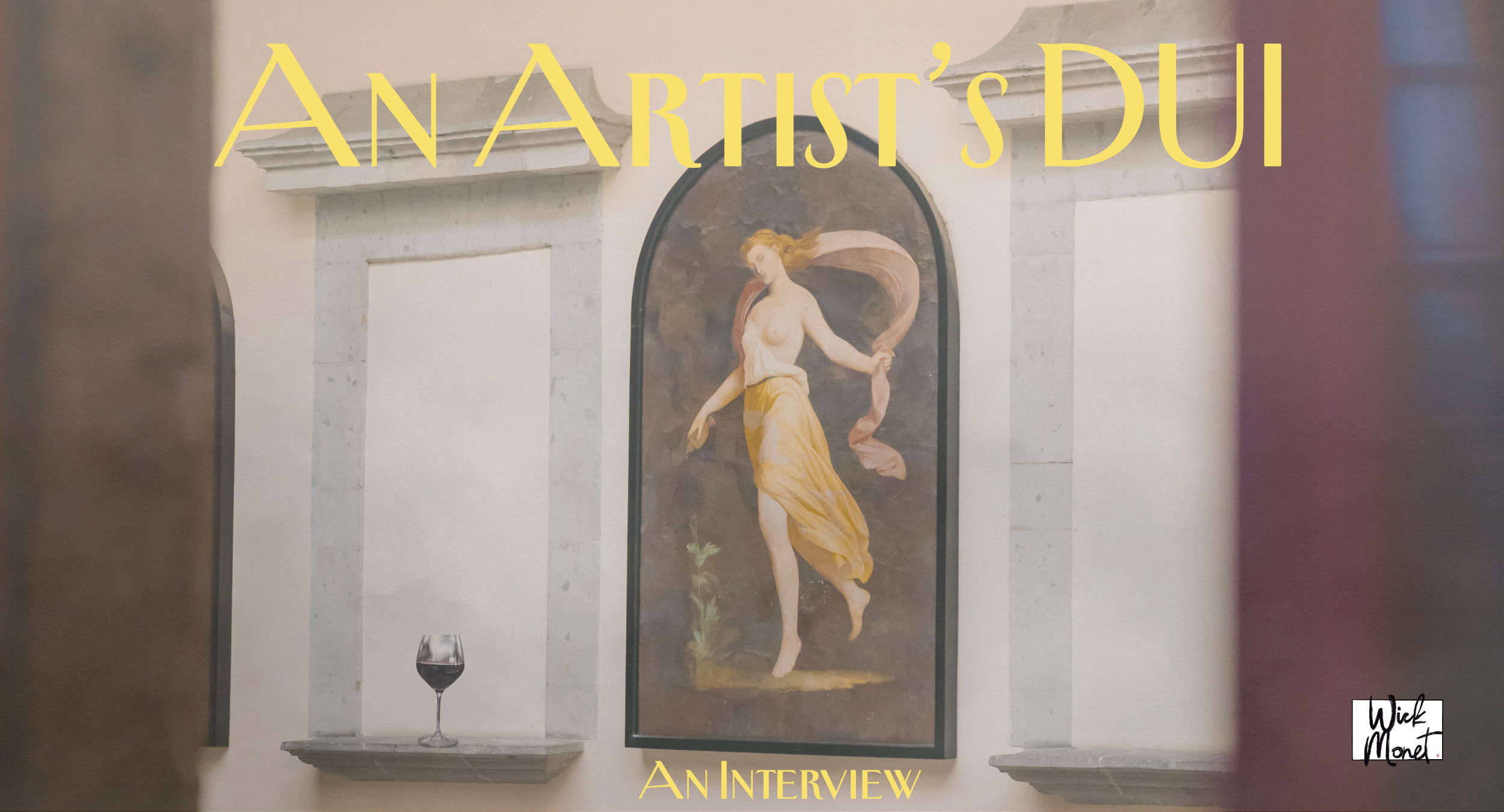
Driving under the influence is not a minor mistake. The risk of injury or death is too serious to dismiss, and no circumstance makes impaired driving responsible. Still, it happens.
The artist in this conversation was recently charged with a DUI and is still moving through the legal and personal consequences. This piece is not an argument in her defense, nor is it an attempt to extract a clean lesson from what happened. It is one person's account of her decisions, regrets, contradictions, and hopes for what comes next.
Neil: So, recently you've gotten a DUI.
Artist: Yes. It was in November. 2025.
Neil: What were the circumstances behind it?
Artist: I got pulled over for running a stop sign, which, I run stop signs, at night, because I'm a woman who drives alone in her car. I won't be stopping that anytime soon. I was taught that someone might be able to get in your car. You're all by yourself. Never mind that my car automatically locks, but that's okay.
Neil: Is that when you see car lights behind you, or is it just...?
Artist: No. If I'm somewhere and there are no other cars on the road, I will not pay attention to the lights or the stop signs because I'm trying to get home, and I'm not about to stop my car and risk something because I was told horror stories when I was younger.
Neil: What was the experience of that night like?
Artist: Yeah, I think I'm surprised at my behavior that happened after getting pulled over because, I mean, yes, I had had drinks, and yes, it was not appropriate that I was driving.
I was confused about where my wallet was, but that's because I had two jackets. I wore one jacket that evening and then I put on the jacket that was on the front seat. I had my laptop bag in the back, and I just couldn't remember in which item my wallet was. So, as I was trying to figure that out, that is when he started asking me questions about drinking, and then I had to get out of the car. And I don't remember my behavior. I read the police report. It took me a couple days to read it because I was terrified of reading it. I was charged with running a stop sign, the DUI, and, what is the wording? I can't remember the term for it, but it's like bad behavior, essentially.
And when it was clear I was not going to be allowed to go home, that I was in trouble, then my survival kicked in. And I, of course, had been drinking, so blacking out was not a surprise. But I know that when I am emotionally charged, on top of drinking, I will have an altogether different response. And I began screaming and did not want to be handcuffed, and I was kicking at the officers and making it very difficult for them to get me into the car. They didn't have to take me very far to sit in a holding cell. I was very close to home as well.
But I know, because of my trauma, being alone in the dark with men surrounding me, trying to put me in a car. I don't care that you're a police officer. I don't feel protected by you right now. I feel like you're treating me like a criminal, even though you can see my record. Nothing like this has ever happened before. And so I think that was something I've looked back at as, like, they're taught to treat you like you're a horrible person. They're not actually trying to protect you, the person that has now made some mistake. And my mistake was that I ran a stop sign. So, yes, my mistake was also drinking, but...
Neil: And how old are you?
Artist: I'm now 45 years old. Halfway to 90. Woo.
Neil: So, what was it like the day after?
Artist: I woke up confused, but I woke up early with my alarm clock so that I could talk to my housemate, who had picked me up the night before, and to find out “where exactly is my car again? Where did they say? What was the name of that place?” We had been given no paperwork. I didn't understand what was happening next. I had no ideas. I asked what they had told her, and she knew nothing. It just was that, oh, we struggled to get her in here. They went and knocked on the front door to wake up my housemate because I was panicked because my calling wasn't waking her up, and that's it. I was then home. I had my license still. It hadn't been cut up, you know. I just needed to go get my car.
I found out where it was, grabbed a Lyft, and got there at 7:30 in the morning, way before they opened. I wanted to handle it immediately. Luckily, a man who lived on the property let me wait inside until the owner arrived at 10. I walked to the gas station for cash and chocolate milk, because that's what I drink when I'm hungover.
Artist: And then I went back, and I sat in this big cushy chair in the middle of a shop and fell asleep with this old man just looking at his phone and reading the newspaper. And then, at 10 o'clock, when the guy showed up.
“Oh, I'm here for my car. Good morning.”
And then I drove my car home.
Approximately 1 in 50 drivers in the U.S. has had a DUI incident in the past five years.
About one-third of all drivers arrested for drunk driving are repeat offenders.
Neil: So, you didn't have any paperwork. How long was it from the moment of your interaction with the police to the start of the legal process?
Artist: I mean, it was within days because I wasn't satisfied that I had just picked up my car and didn't know what was happening. So I researched myself, and I found the police report, and so I knew what was happening. And then notice came in the mail. So it was pretty quick that I got the information that I was being charged with something. Still, I didn't understand what was going to happen next. And then I started getting all of the–I was on all the mailing lists for the lawyers, so I got every fucking advertisement for local lawyers. Everything just started coming in the mail, five and six at a time, and I was like, okay, well, I'm in the system, in this way, now.
Yeah, honestly, it's been scary to become part of the system like this. Because here's the thing: I refused to give them an indicator of where I was at, no blood alcohol level. I didn't know what refusing meant. Whether they explained my rights to me or not doesn't matter. I was in a state of mind that was not comprehending anything at that moment. I was feeling attacked, so I was not going to comply. Honestly, part of me thinks, “good job. I'm glad that's how you respond. I'm glad, in these moments of survival, you fucking fight.”
Artist: I'm not mad about that part. I will always be a fighter. That's just what I'm made of. So, I think I'd rather go out fighting, I guess.
Artist: But because I didn't provide all this, I had to then go in separately, when I'm sober, and provide a photo and do my fingerprints. And so that was a whole thing, you know, meeting the people who work in these jobs and being like, “Hi, I'm here for this thing because I'm a criminal now. You work with criminals. Well, I'm here because I'm a criminal. I'm being accused of being a criminal. I'm not a criminal, but I did a criminal act according to law.” And so it's just something to be reckoned within yourself.
You know, first time for everything.

Neil: And so, obviously, the legal process took months.
Artist: Yeah. But then, having gotten an attorney and then going through the first time where I had to show up in front of the judge, that first appearance, I think, was within the first month. And that's where the attorney came in and kind of stated what we wanted out of the process. And that was our, or my, opportunity, I guess, to appeal to me not being a criminal. So, thankfully, my attorney knew the cop, and so they were like, “She seemed to just be a good person having a bad day.” And so then I found myself getting the better of the punishment.
I was supposed to go to court. I don't even remember now. I think it was, like, February. And then I showed up, and they were like, “Oh, we don't have your paperwork yet, so we can't do anything.” And so they pushed me out to, I think, May. And I was like, “What the fuck? I have to wait so long. This is gonna take forever.”
So I still have court things I have to deal with, but it's like, I don't know. I don't know. There's a lot of feelings attached to it. I guess I'll let you ask me more questions, and then we'll see what comes out.
Neil: Can you give me a summary of your total consequences?
Artist: I'm in the ARD program, which is accelerated rehabilitation something, and it's for first-time offenders. Essentially, it gives you an opportunity to right your wrong and not have it on your record. My record will be expunged. Background checks won't have this on there, so it won't be held against me in the future.
I have to do12.5 hours of alcohol highway safety class, which I just completed last weekend and four weeks of group meetings. Four consecutive Wednesdays, for three hours at a time, to talk about this experience and what I've learned and to hear about other people's experiences. And I have to be sober for those things. If they think I'm not sober, or anybody in the class is not sober, we all have to have our blood alcohol tested. And if any of us have anything in our system, then, you know, we will be excused from the class, and it could potentially change the outcome of everything. So you have to be really on the straight and fucking narrow when you're doing it.
Artist: But if you're not, then the question comes in with those who have a medical marijuana card. It's still a substance, regardless if you have that card or not, so that's something that has to be considered. Being in Pennsylvania is interesting because this is a new state to me. Before, it was recreational for me, and you could go into any store, so having a medical marijuana card is kind of a weird thing. I'm learning they don't have a lot of ways to test how much is in your system, but they have enough of a law written that, if you have anything in your system, they can charge you with a DUI. It's not just alcohol.
Artist: Yeah, it could be prescription drugs. You know, I remember I started taking an antidepressant, and I remember my doctor telling me, that it's gonna make you feel as though your head is floating for a little bit. “I have a history of dissociation, so I know what that feels like.” Until one day I was driving my car to work, and I was looking at my hands on the steering wheel, and I was like, I don't feel... I know those are my hands, but I don't feel them. I'm so not connected to my personhood at the moment, and that's not safe for me to be driving on the fucking freeway like that. So, I mean, I've learned a lot in this process already. I also have to go to three AA meetings, and then for ten years, I cannot get another DUI, because if I do, it will not be considered a number one. They will now open up my record, and I will be counted for now a second.
Neil: It’s now nine months from when you got your DUI. What is your life like now because of it?
Artist: My license is also suspended for 60 days, so I can't drive my car, right now. In Pennsylvania, if you refuse to provide your blood alcohol level, it's your right, but you will have an automatic one-year license suspension. I didn't know that, of course. I didn't know because I'm not a criminal. I don't know the law that closely because I'm not a criminal having to argue it for myself. But now I know what it is.
Because of the deal I made at that very first court hearing with my attorney, they dropped the lesser charges and reduced my DUI. Unfortunately, PennDOT has an automated system, so I still got the letter saying that my license would be suspended for a year. My attorney and I had to appeal that letter, and my court hearing is happening in August. My attorney thinks it will be okay, but I could still have to face the year. If I do, I will lose my job because my job is driving.
Thankfully, because I work in the mental health field, in recovery, I was able to talk with my supervisors and work out a way for me to continue in my role, taking the bus and riding my bike. Now that's my challenge: How do I get to where I need to go? How long is this going to take me? It's very difficult to not be able to be on my own timeline. I am subjected to the timeline of my physical body or the bus systems, the hills in Pittsburgh.
I've also lost my home. My DUI experience, I think, was too much for the friend I lived with, and I did not realize it was impacting her so greatly. I've had to find a temporary spot and lose my car at the same time. Things are not familiar again. The Pittsburgh I am interacting with is not a Pittsburgh that I was introduced to, and it's one of my own making now. I don't have someone else's lens. It's teaching me a lot.
Neil: What was your view on people with DUIs before and what is it now?
Artist: I have some friends who have gotten DUIs. After my experience, I learned quite a few people have faced this. This is pretty common because drinking alcohol is common everywhere. I was most shocked to see it written down, see a number attached to it, but not surprised that more people will drive intoxicated 80 to 90 times before they would ever get pulled over. And I certainly have lived quite a 20-something years. I didn't know that I was a person who needed to experience this, but things impact me greater once I have an experience, and that's when I get to actually learn the lessons about it.
I have been leaning on my friends who have told me about their DUIs. That helps me to not feel like I'm a horrible person, because in my upbringing I never was around drinking. It was talked out of the side of mouths as, like, “We have some of those kinds of people in the family, but we don't spend time with them. You don't drink.”
The fact that I do drink, and I drank enough and had enough negative experiences with drinking that I have to question my behavior. I wonder, what are my genetics, and where do I come from that I don't even know about because my family won't talk about it? They wanted to shelter me from it, but that's just as much a part of me as anything else.
I have a lot of questions about me and drinking and other family members who might have resorted to drinking. For what reasons did they do that? I don't know because I wasn't around those people, and now I'm estranged. A lot of people are dead anyway. Maybe it really doesn't matter because I can just look at myself and assess my own behavior. I don't really need to know some uncle down the line, what his issues were. It's in me. If I just mine myself for it, I'll find it.
Neil: This identity of “criminal.” What does it mean to you?
Artist: Oh no. I just hear Fiona Apple singing. Yeah, '90s kid, I guess. Well, I guess technically I'm an '80s kid, but I wasn't really focused on music until the '90s. So, yeah, that's why I say '90s kid.
But, yeah, criminal. You know that a synonym for the word “queer” is “unlawful,” and when I came out to myself as queer, I think I started to embrace criminal behavior. I certainly have shoplifted like nobody's business coming across the country. I mean, I never paid for a meal coming across the country unless I went into a restaurant and sat down.
I just would walk into the grocery store, pick out what I wanted to eat, walk past people who work there and say, “Thank you,” and, “Goodbye,” and, “I'm on my way,” and they would wish me well, and I'd walk out the door with free food.
Artist: I am a criminal. Yeah, absolutely. Rebellious, that's another word. But some of my rebellion, I'm fine with. You know, what does that mean? Am I an activist? There's all these other things attached to criminal behavior that I'm not necessarily... It's not off-putting to me that it's inside of me. But being caught and then treated the way I was treated, in such a way that my survival kicked in. If I would have been treated with another type of kindness, like I was a nice person who was just having a bad night, then I perhaps would have responded in a different way.
But I was treated in such a way that forced out my survival response, and that's what makes me feel criminal. That is my fucking disability. PTSD. Add that C in the front because it's childhood-based.
Neil: And so, do you think, if you were caught shoplifting, you'd have the same feeling toward the criminal identity?
Artist: With shoplifting, I'd be like, “Well, well, you got me,” because here's the stolen item. But with alcohol, I'm like, “you don't know what I've had. It's inside of me.” The secret-keeping part of me that wants to have privacy, and not everyone needs to know everything. It's not your business until it needs to be your business.
But, like, if I was caught shoplifting something, then clearly it's on my person, and I can't necessarily say I didn't do it. I might ask what can I do to right this wrong? Can I just give this back? Can I stay out of the store forever, or are you going to press charges? And what do I need to face? What do I need to be responsible to now?
Because now that I know what I need to be responsible to, I'm being responsible because I'm a responsible person.
And I do want this chapter to go away. I don't want to get more involved in the system in any way, so I've also not been shoplifting while I've had my name attached to a court. You just stop. And it hasn’t actually been hard to stop. It's like those little quiet rebellions you have until you're caught. And then you're like okay, “well, I got to figure out a different way to rebel now. So how can I do that? What do I need to do now in my rebellion?”
Neil: How has this impacted your artistry, if at all?
Artist: My creativity is my medicine. That flow turned on during COVID, and it has never turned off. I'm grateful because it's where I go to not want to unalive myself. I make meaning of everything that I go through, and I'm developing confidence in myself in new ways because I can make meaning of it.
I'm working on a book right now, and I didn't know where to end it. I didn't know what the last part of the story was. Because I didn't know that last part, I didn't know how to edit some of the things out, so I was holding on to a lot. As soon as this DUI happened and all the conditions started to show up for me to have to take care of, that's when I lost my home and lost access to my car. I have to become very creative in how I live day to day now. I can't let it beat me, and I can't let my disability get me down in my symptoms. I have to now fucking rise to the occasion. The only way I can do it is to make meaning, and so I create.
Now I've written the last poem of my book, and I know exactly where it ends. I've cut 50,000 words of edits this week because now I understand what this was all supposed to teach me. I feel like I could leave Pittsburgh tomorrow and wrap up the story of my time here really well. But I have to fulfill my requirements now, so I'm trapped. It's very curious that I would trap myself in a place. I have done this to myself. I'm the only one responsible for what has happened in my world. I made the decisions. I followed through. I got myself picked up in the system, and now I have to figure out how I want to change it.
Everything was taken away at one time. You're just at the fucking bottom. Then you pull yourself out of it, and then you'll find a new bottom. Here I am again at the bottom. But I've been at the bottom before, so maybe I left some tools down here that I can pick up and use to climb up out.
That's exactly what I know to do now with my creativity, because I create the ladder to get me out of the hole. I am the creator. So I guess that means I'm really an artist, huh? It's the truest role that I've found for myself in this life so far. When I call myself an artist, I suddenly can do way more than I thought I could.
Neil: Who do you want to be after this?
Artist: Can you define this?
Neil: When you get your car back, perhaps?
Artist: That's brings curiosity. I have such an itch right now to take care of these responsibilities and then be irresponsible and run. Quit my job. Give Pittsburgh the finger. Fucking leave. The test will be to not do that. The test will be to set a goal that's going to be good for me and to take steps that will get me across the country in a better condition than if I were to cut and run, because that's just so typical. There are many memories on which I can look back–was I running away, or was I making deliberate change?
Now knowing myself a little bit better. Well, I don't want to run away from things. So I'd like to find my own little spot in Pittsburgh to hole up by myself for a minute and live alone here and see what I can make of myself before I go. But I have a lot of art that I've collected and made that I intend to scatter all over the city before I go. I’ve carried it around in my car, so that I always have it available to leave at places. But now I don't have my car to drive, so it's harder to carry on a bike. You might start seeing my paintings on buses. I'll just leave them.